
Developing Roadway Design Guidance that Endures

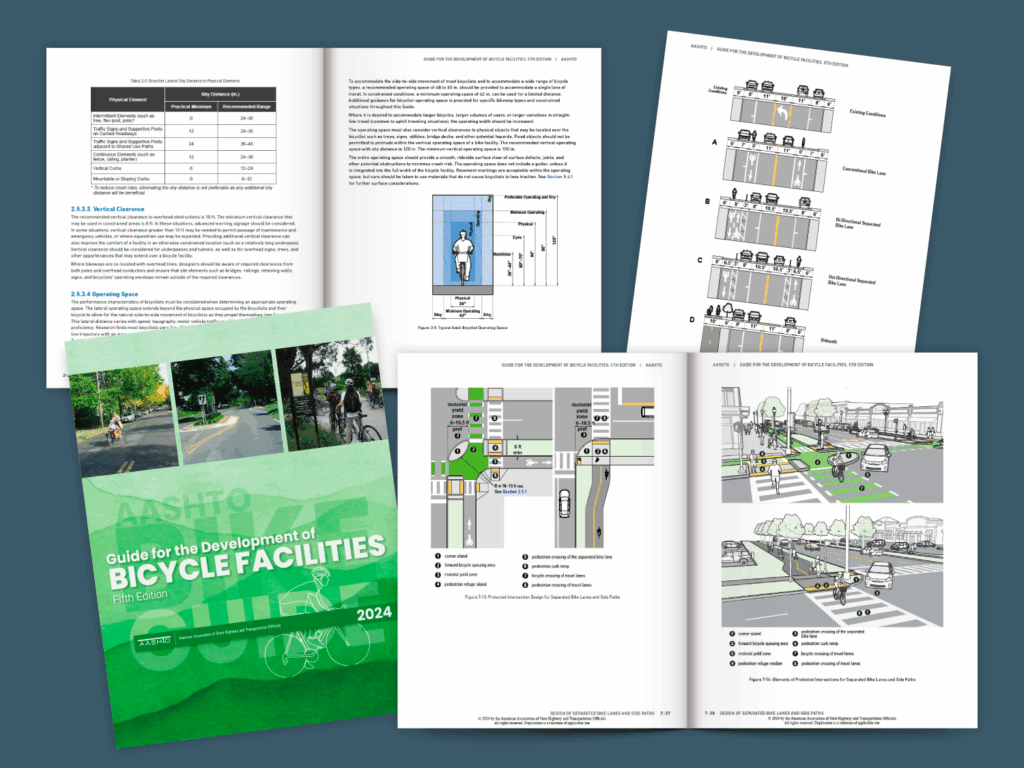
In December 2024, we celebrated the release of the AASHTO Bike Guide. One year later, in December 2025, we kicked off the NCHRP research study that will become the foundation for the AASHTO Pedestrian Guide. We’re honored to have been selected as lead authors of these two cornerstone manuals for transportation design, and we’re taking the occasion to reflect on what it takes to develop effective, enduring design guidance.

Technical expertise is a must.

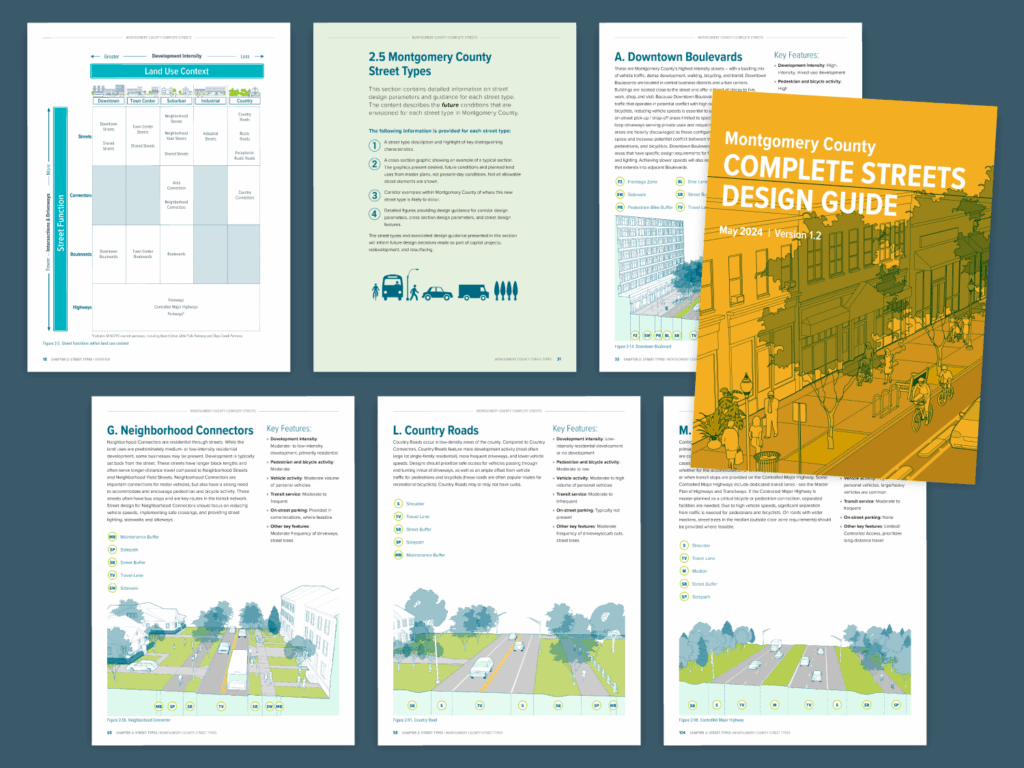
Thorough technical knowledge and subject matter expertise are, of course, essential for authoring design guidance. Our engineers, urban designers, landscape architects, and planners bring years of experience designing multimodal roadway projects for state and local agencies across the full range of contexts. They know their way around the AASHTO Green Book, MUTCD, PROWAG, the Highway Capacity Manual, and state and local guides throughout the United States, applying these standards alongside urban design, landscape architecture, and planning perspectives to deliver context-sensitive solutions.

meticulous research Matters.

Creating effective design guidance requires not just technical prowess but the practical application of research. For example, the AASHTO Bike Guide was thoroughly researched and referenced (as will be the AASHTO Pedestrian Guide) so readers can understand the basis for the guidance. Every statement, dimension, and recommendation must be reviewed, vetted, and refined to ensure it is accurate, defensible, and useful in practice. This level of rigor is critical for guidance that will be used daily by engineers making complex decisions under real-world constraints.

Guidance must be Adaptable.

From the outset, Bill Schultheiss and the AASHTO Bike Guide project team understood that national-level guidance must be adaptable to the needs of a wide variety of state and local agencies. “At the end of the day,” Bill noted, “a super-majority of more than 35 state Department of Transportation (DOT) agencies had to sign off on the document, so it needed to support a range of contexts and approaches.”

The Guide includes instances where engineering judgment is appropriate, while grounding that judgment in established engineering principles, professional ethics, and research. Successful guidance does not exist in a vacuum — it must align with other widely used guides and resources so that practitioners can apply it confidently and consistently while also providing flexibility to achieve local community goals.

Successful guidance does not exist in a vacuum — it must align with other widely used guides and resources while also providing flexibility to achieve local community goals.

And it must complement current practices.

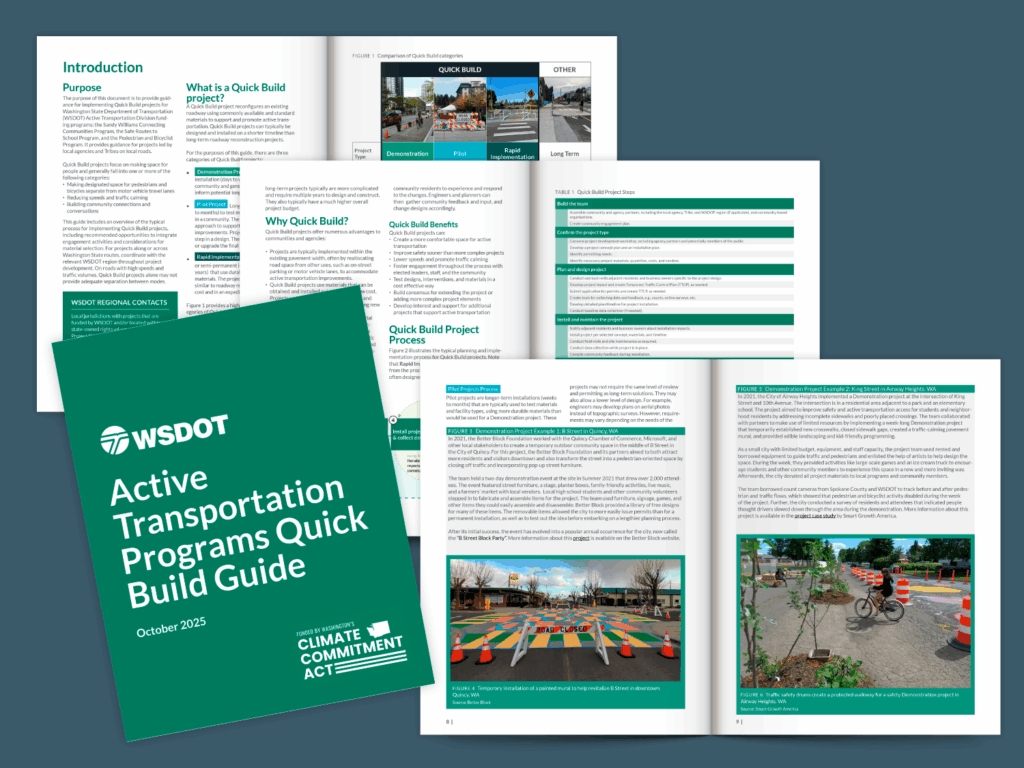
Knowledge of existing design standards and practices was critical for Amalia Cody in leading the development of a Quick Build Guide for the Washington State DOT’s Active Transportation division. Amalia explained, “We are writing guidance that draws on existing agency standards and specifications, as well as relevant national manuals such as the MUTCD, that municipalities rely upon to implement projects locally.” Balancing statewide consistency with flexibility for context-sensitive local projects was possible, she says, “because we held listening sessions with practitioners in all corners of the state and every section of the agency to make sure we understood current practices.” The resulting Guide not only anticipates design challenges, but also accounts for operations and maintenance impacts.

insider knowledge Helps.

One of our design guide veterans, Ashley Gunderson, credits her time working in the South Carolina DOT construction division for critical insights that inform her approach to projects. Earlier this year, reconstruction of West Main Street in Spartanburg moved quickly through design review in part, she says, “because I could anticipate and proactively address SCDOT concerns about things like roadway capacity, turning radii for large trucks, and provisions for emergency vehicle access. We only had two rounds of review for a complex and innovative project that included the state’s first parking protected bike lanes, wider sidewalks, and an enhanced public realm on a critical downtown street.” State agency experience puts our team a step ahead when implementing innovative projects that meet both state design standards and local community needs.

Three photos labeled from left to right: Concept, Construction, Completion to demonstrate how the City of Spartanburg and South Carolina DOT worked efficiently to move the project from concept to completion.
Our project team worked alongside the City of Spartanburg and South Carolina DOT to efficiently move this reconstruction from concept design through to completion.

Always show your work.

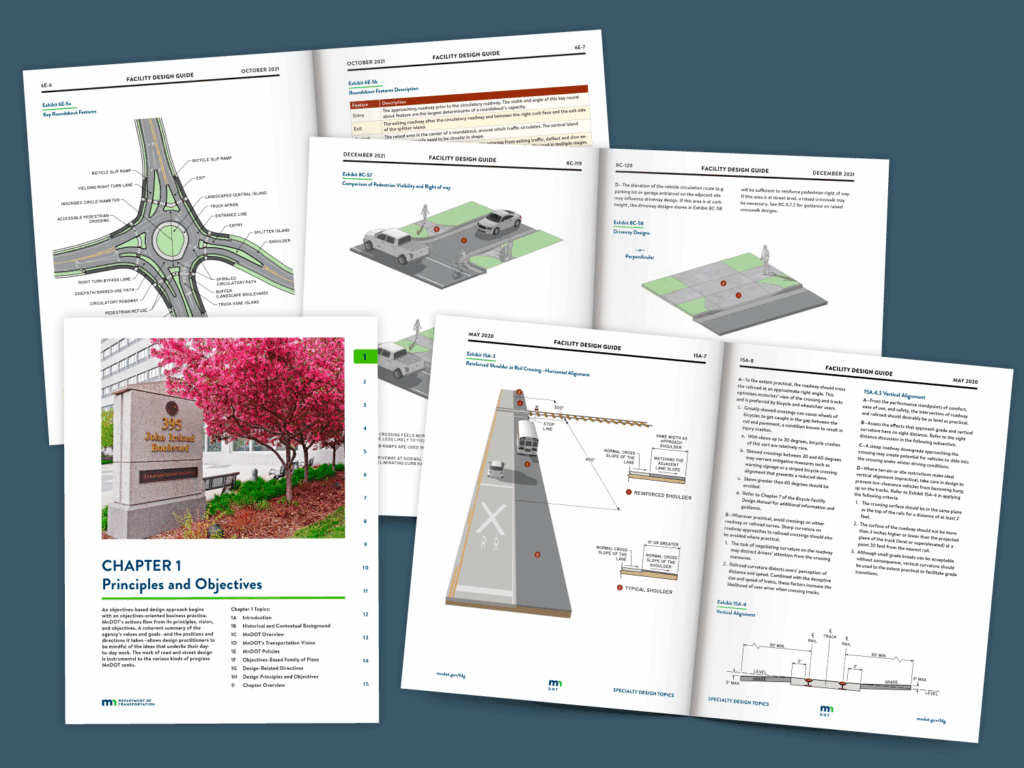
Ashley also stresses the importance of clear documentation: “I document the reasoning for every decision and the philosophy behind the design approach,” she explains. That same discipline was critical for Noah Halbach and team when developing more than 300 graphics for the Minnesota DOT’s Facility Design Guide. To ensure consistency and usability, Noah noted, “we created a style guide and process document to ensure we had an efficient system for creating high-quality products, applying Minnesota DOT MicroStation templates wherever possible.” The resulting graphics feel familiar to users and are consistent with graphics in related manuals and documents. This attention to detail — tracking decisions, managing revisions, coordinating approvals, and maintaining references — ensures consistency and continuity in delivering effective design guidance.

Good guidance helps the practitioner adapt design standards to balance competing constraints and apply context-sensitive solutions.

reality is the real test.

These insights mirror my own experience working for the Massachusetts DOT, where I helped both write and apply design guidance. Many guidance documents provide simplistic directions: if x, then do y. In reality, almost every design project — particularly a complex multimodal roadway design — presents issues that are at odds with simply doing y. Good guidance helps the practitioner adapt design standards to balance competing constraints and apply context-sensitive solutions.

Stay open.

Lastly, despite all our credentials and experience, we recognize that we don’t have all the answers. No one does, in this wide-ranging and ever-changing industry. I recently led an NCHRP research report on the importance of pedestrian safety at night, and the findings were genuinely eye-opening, even after so many years of working in this field. Great guidance requires staying curious, revising assumptions, and remaining open to new information across disciplines and areas of practice. That humility and commitment to learning are what allows design guidance to remain relevant, trusted, and effective over time.

Michelle Danila

Director of Engineering Operations
Michelle serves as Toole Design’s Director of Engineering Operations. She focuses on making communities more livable by ensuring that our...
See All Articles Next Article