Skip to content
Toole Design
  • About Us
  • Expertise
  • People
  • Insights
  • Careers
  • Contact
  • Search

This post is co-authored by Trails Practice Lead Jeff Ciabotti and Project Planner Kelsey Walker.

Credit: Adolphe Pierre-Louis

Three years ago, the Albuquerque Rail Trail was still just an idea. Fast forward to 2025 and the first segment is open, with more segments under construction. As anyone who works on trail design and trail-building knows, that’s some fast work. Albuquerque’s commitment to the project and to sustaining its momentum — even amidst federal funding shifts — is the driving force behind the Albuquerque Rail Trail’s record-setting implementation.

The timeline is admirable, but the story isn’t unique. It’s part of a movement across the U.S. to use trails as engines for growth. Think of the Indianapolis Cultural Trail or the Atlanta Beltline. Cities of all types and sizes are investing in trails as the new Main Street.

The new Albuquerque Rail Trail signals a growing understanding that a trail is not just a trail: it can be a catalyst for economic development, climate resilience, physical and mental health, and community connection. Done right, trails can awaken a city in a way no other public infrastructure can. Read on to learn how Albuquerque has taken this to heart.

1. Assembling the Right Team

The City of Albuquerque showed great foresight in tapping both the Metropolitan Redevelopment Agency (MRA) and the Department of Municipal Development (DMD) to collaboratively lead the charge on the Rail Trail. From the start, the project has been part of a broader vision for economic revitalization, integrating the tenets of Trail-Oriented Development (more on TrOD below). Wisely, the City also seeded a Friends of the Rail Trail group early on to harness public support and build momentum. And they brought on a multidisciplinary team of consultants to bring the vision to life. 

By making these smart moves at the outset, Albuquerque achieved the three pillars of successful trail development: public agency leadership, strong public support from an organized coalition, and a framework plan that lays out how the project can get done.

We’re not just building a trail in a community. We’re building the community into the trail.

Jeff Ciabotti, Trails Practice Lead

2. Starting with the past to build the future

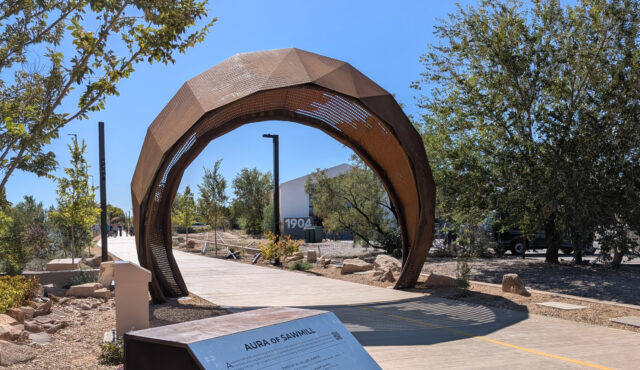
The City collaborated with the world-renowned Antoine Predock, who spent most of his life and career in Albuquerque, to create a trail vision that honors Albuquerque’s history, heritage, and place. Predock identified nine zones or “auras” along the heart-shaped, 7-mile loop that celebrate what makes the city unique. These include the Aura of Sawmill — the completed segment that opened in late October — named for the lumber yards that gave rise to the neighborhood. Other auras include Tiguex, named for the people who first lived here and whose descendants contribute to the city’s present and future culture, as well as 66, named for the famous Route 66 that passes through Albuquerque.

Currently in design is the Central Crossing, which will feature an iconic feature of the New Mexico landscape: a giant tumbleweed sculpture.

Credit: Antoine Predock Architect

3. Getting the technical design right

Of course, the Albuquerque Rail Trail itself needed to be fantastic. That required a design team that understands the state-of-the-industry standards for trail design and can solve complex design challenges along the way. The City assembled a design team led by Wilson and Company, with Pland providing landscape architecture services and Toole Design bringing multimodal design and implementation expertise.

The team collaborated on a design that integrates with the terrain’s natural curvature and elevation and that connects with existing trails and on-street facilities. That effort involves design challenges and thoughtful coordination with partners, including railway companies, as the route will cross over and run parallel to several active railroad lines.

Trail design for Central Crossing

4. Looking beyond the trail itself

A successful trail project is about much more than the trail. Trail-Oriented Development means looking beyond physical infrastructure to integrate with things like housing, accessibility, and local business culture to bring deep and sustainable value to the community. 

The ingredients for Trail-Oriented Development include:

  • Public policies: Flexible zoning; development standards; affordable housing incentives; and strategic partnerships for managing, funding, and maintaining the project.
  • Inclusive growth: Strategies to promote neighborhood stability and vibrancy, documented in Advancing Inclusive Growth through the Albuquerque Rail Trail.
  • Performance measures: Tracking jobs, housing, transit access, access to services and infrastructure, and more to understand the trail’s impact. 
Trail-Oriented-Development-Playbook_cover
Trail-Oriented-Development-Playbook_p5
Trail-Oriented-Development-Playbook_p7
Trail-Oriented-Development-Playbook_p15

5. Building momentum that won’t quit

Even with threats to funding, the momentum for the Albuquerque Rail Trail is strong, with another segment ribbon-cutting planned for the spring and additional segments in final design. With a solid base of agency leadership, public support, and clear vision, this rail trail is moving full steam ahead.

Not every project will look like Albuquerque’s — nor should it. But when the vision and the plan are intrinsically connected to the needs of your community, your trail project can move surprisingly steadily from just an idea to this:

Credit: Downtown Albuquerque News
Credit: Adolphe Pierre-Louis
News Publications Research
  • Albuquerque Seizes the Power of Urban Trails

    11 / 04 / 202503 / 12 / 2026News
  • Safer Vehicles in Cities: Five Steps to Advance Vehicle Safety Locally

    09 / 23 / 202509 / 23 / 2025News
  • Shaping Active Transportation With Our 2025 Interns

    09 / 15 / 202503 / 04 / 2026News
  • Right Turn on Red: It’s Time to Reconsider

    09 / 11 / 202509 / 11 / 2025News, Publications, Research
  • Our Conversation with Author Charles T. Brown

    09 / 10 / 2025News
  • Get to Know Nina Ndichu, Austin Office Director

    08 / 13 / 202508 / 13 / 2025News
  • Pla(y)cemaking: Planning and Designing Streets that Spark Joy

    08 / 12 / 202508 / 12 / 2025News
  • Meet Natalie Lozano, Director of Market Strategy, Western U.S.

    07 / 15 / 202507 / 16 / 2025News
  • Looking Ahead to ITE 2025 in Orlando

    07 / 11 / 202507 / 14 / 2025News
  • Meet Angie Byrne, Safety Practice Lead

    06 / 11 / 202506 / 11 / 2025News
  • Meet Paul Lippens, Michigan Market Lead

    06 / 05 / 202506 / 06 / 2025News
  • Centering Youth in Your Safety Story

    05 / 06 / 202507 / 30 / 2026News, Research

Posts navigation

Older posts
Newer posts
Connect with us
  • LinkedIn
  • Facebook
  • Instagram
  • YouTube
Subscribe to Our NewsletterSubscribe to
Our Newsletter
  • About Us
  • Expertise
  • People
  • Insights
  • Careers
  • Contact
Affiliates Non-Discrimination AI Principles
©2026 Toole Design, Inc.